News
Use Data Analytics to Increase Sales
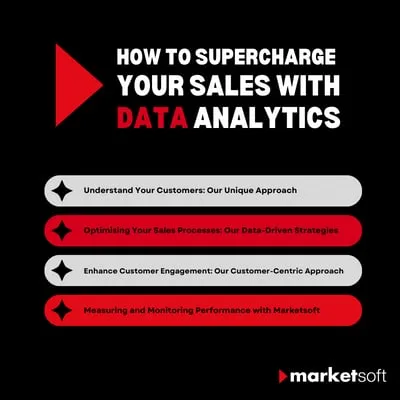
At Marketsoft, we're dedicated to helping you improve your sales with data analytics.

News
Data is a powerful tool for enhancing the customer experience, but it must be handled responsibly and securely.
24 October 2023 · Alison Feuerstein
In a highly competitive business-to-business (B2B) market, creating an exceptional customer experience is not just a nice-to-have - it’s a must-have. But achieving this can be a challenging endeavour. Fortunately, data can be a powerful ally in your quest to deliver a superior B2B customer experience. In this blog post, we will explore how B2B organisations can use data to enhance customer experiences, thereby gaining a competitive edge in their industries.
Before looking at data-driven strategies, it’s crucial to understand what a remarkable B2B customer experience entails. Unlike in the business-to-consumer (B2C) sphere, B2B interactions are often more complex and long-term. Key elements of an excellent B2B customer experience include:
Let’s explore how data can be effectively utilised to achieve these goals.
One-size-fits-all approaches seldom work in the B2B realm. Data-driven customer segmentation allows you to categorise your customer base into distinct groups based on characteristics such as industry, company size, location, and purchasing behaviour. By doing so, you can tailor your marketing efforts, product offerings, and customer support to cater to the specific needs of each segment.
For example, if you identify that a particular industry segment prefers self-service options, you can invest in developing a user-friendly online portal while providing more personalised assistance to another segment that values one-on-one engagement.
Predictive analytics uses historical data to forecast future trends and customer behaviour. B2B companies can use predictive analytics to identify potential high-value customers, forecast demand, and even predict when a customer might be considering switching to a competitor.
By proactively addressing customer needs based on these predictions, you can stay one step ahead, ensuring that your customers are delighted with your proactive approach to addressing their challenges.
In today’s fast-paced business environment, real-time data insights are invaluable. Monitoring customer interactions and behaviour in real-time enables you to respond promptly to any issues or opportunities that arise.
Implementing real-time analytics tools allows you to track website visits, email opens, and other engagement metrics. If a key customer is browsing your website, you can quickly arrange for a sales representative to reach out with a personalised offer or relevant information.
Integrating your customer relationship management (CRM) system with your data sources is essential for creating a smooth customer experience. A well-integrated CRM provides a centralised hub for customer data, allowing your sales and support teams to access a 360-degree view of each customer.
With this holistic view, your teams can provide more personalised service, track customer interactions, and identify cross-selling or upselling opportunities.
Customer feedback is a treasure trove of information. Collecting feedback through surveys, reviews, and direct interactions is essential, but analysing this data is where the real value lies.
Utilise natural language processing (NLP) and sentiment analysis tools to look deeper into the feedback. Identify common pain points, recurring compliments, and areas for improvement. This data-driven approach can guide product development, marketing strategies, and customer support initiatives.
Data-driven automation can streamline various aspects of your B2B customer experience efforts. For instance, chatbots powered by machine learning algorithms can provide instant responses to common customer enquiries, freeing up your human support agents to tackle more complex issues.
Automated marketing workflows can also deliver targeted content and offers based on a customer’s behaviour and preferences, enhancing their overall experience.
While data is a powerful tool for enhancing the customer experience, it must be handled responsibly and securely. B2B customers entrust you with their sensitive information, and any breach can severely damage trust and reputation.
Ensure that you have robust data security measures in place, comply with data protection regulations, and communicate your commitment to data privacy to your customers.
Creating a better customer experience in the B2B arena is a multifaceted endeavour that relies on the strategic use of data. By embracing customer segmentation, predictive analytics, real-time insights, CRM integration, feedback analysis, automation, and data security, you can transform your B2B customer experience into a competitive advantage.
Remember that the key to success is not just collecting data but using it intelligently to deliver personalised, responsive, and efficient interactions that meet your customers’ evolving needs and expectations. Ultimately, data-driven excellence in the B2B customer experience will set your organisation apart, drive customer loyalty, and foster long-term growth.
Keep exploring
News
At Marketsoft, we're dedicated to helping you improve your sales with data analytics.
News
One of the most significant shifts in marketing is data-driven strategy.

News
When organisations take the time and effort to get to know their customers, everyone benefits.
No pressure. No obligation. Just a practical conversation.
Or call +61 2 9432 7400
We’d like to use analytics cookies to understand how our website is used, so we can improve it. They’re only set if you accept. See our Cookie Policy.